

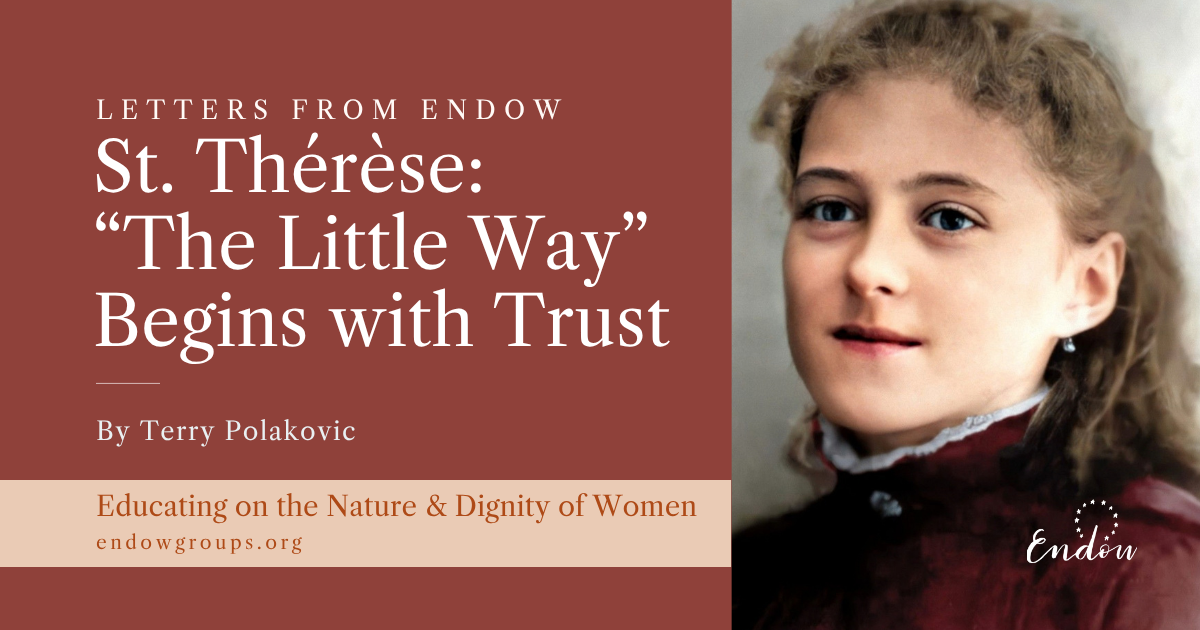

By Terry Polakovic, co-founder of Endow
St. Thérèse of Lisieux evokes simple thoughts: little things, little sacrifices, little acts of love, the Little Flower and the Little Way.
Thérèse’s path to this spiritual childhood was shaped by the painful losses of those she depended on. Through those losses, she learned what it meant to depend completely on God.
Born Marie-Françoise-Thérèse on January 2, 1873, in Alençon, France, Thérèse was the youngest of Louis and Zélie Martin’s nine children. Four of those children died young, leaving five daughters, all of whom eventually entered religious life.
Zélie was already suffering from breast cancer when Thérèse was born and was unable to nurse her. Thérèse was sent to live with a wet nurse, Rose Taillé, with whom Thérèse bonded for a year before returning to the Martin family. Her four older sisters doted on her. Her father called her his little “Queen,” and she called him her “King.”
At the age of four, Thérèse was profoundly affected by the death of her mother. She called the years that followed “the most painful” period of her childhood, years in which Therese became extraordinarily sensitive and easily wounded.
On Christmas night in 1886, when Thérèse was nearly fourteen, she received what she would later call the grace of her “conversion.” This conversion led to the doctrine attributed to Thérèse, namely the “Little Way.”
Thérèse began to turn outward and away from her inner wounds, giving her abundant strength to love others in the little encounters of every day.
The Little Way
The Little Way is a spiritual path that focuses on achieving holiness through every day, ordinary actions done with great love.
It consists of small actions that do not require grand or heroic deeds. Instead, it is found in simple tasks like picking up a dropped pen or offering a kind word.
Her way is a way of spiritual childhood, where a child trusts completely in a loving parent and relies entirely on God’s mercy. Finally, her way is a way of little sacrifices, including patience with daily frustrations, patience with difficult people, and hidden kindnesses offered to God.
Thérèse understood she did not have to be spiritually impressive before God to become holy. She could come before God as she was, weak, dependent, and in need of mercy. Her very limitations became places of encounter with God, where she learned to trust Him more completely.
Depending on God
We live in a culture that tells us to prove and improve ourselves, making ourselves worthy of being loved. Thérèse teaches us to see our identity differently. Our deepest security comes from knowing whose we are and upon Whom we can always depend.
That truth changes how we respond to the difficulties of ordinary life.
One day in 1897, still in her early twenties and weakened by tuberculosis, Thérèse was sitting in her wheelchair in the convent garden. Ordered by her Prioress to complete an account of her childhood memories, she was trying unsuccessfully to write.
Thérèse wrote about being interrupted by one sister, who stopped to chat about hay, ducks, hens and the doctor’s visits. Another tossed flowers into Thérèse’s lap.
Thérèse found the interruptions irritating. She was tired and wanted quiet. She wrote that, “for the love of God and my sisters, I take care to appear happy and especially to be so.”
That is the Little Way. No matter how irritated we feel, we can choose to freely love amid the daily inconveniences we neither make nor choose.
It’s not easy. We too will be given interruptions, difficult people, tedious work, disappointments, family demands, and unmet expectations. We can open ourselves to create and walk through small moments of great love even when we would prefer something other than the challenges placed before us.
Thérèse teaches Endow women not to redirect those challenging moments, for the circumstances of ordinary life are integral to our formation. They are often the very place where God is forming us.
St. Thérèse of Lisieux, beloved Doctor of the Church, pray for us.
About the Author
Terry Polakovic is the co-founder of Endow and served as president of the organization from 2003-2015. Before retiring, she worked in nonprofit leadership for more than 30 years. In 2010, she received the Pro Ecclesia et Pontiface Cross Award (For the Church and the Pontiff) from Pope Benedict XVI. In 2011, Terry was recognized as an Outstanding Catholic Leader by the Catholic Leadership Institute.
Host Mentor Call
Interested in hosting Endow? Schedule a Host Mentor Call to get started and be supported every step of the way.
Schedule a Call
St. Thérèse of Lisieux | The Science of Love
In this study, you will encounter St. Thérèse of Lisieux, with energy and vigor. Thérèse offers the modern women a fresh perspective on happiness, discipleship and sainthood. She presents her “Little Way” with a dramatic simplicity that continues to scandalize. Thérèse willed just the one thing: to become a saint! You will come to know St. Thérèse, a shockingly original woman who was totally authentic and free, in a whole new way.
Explore the Study